
Mapping India's ODR Stack: From Backlog to Blockchain
A State-of-the-Market Analysis and the Case for Programmable Dispute Resolution

India does not have a shortage of disputes. Rather, it lacks efficient methods for solving them. As of 2026, India has over 5 crore cases pending in district and subordinate courts alone, according to the National Judicial Data Grid (NJDG), with more than 12 lakh cases still in the pre-litigation stage. This is the visible backlog, but across segments such as consumer complaints, loan defaults, and insurance claims, disputes never enter the system itself due to the cost and time involved. Online Dispute Resolution (“ODR”) has emerged not only as a way to reduce court backlogs but also to facilitate the resolution of disputes that could not previously be litigated.
Over the last few years, India’s ODR ecosystem has matured, moving from experimentation to adoption. It is now a multi-layered system comprising Horizontal ODR platforms, Vertical ODR (Sector-specific), Regulators, and Ecosystem Builders. Litigation in India is both expensive and time-consuming. A litigant spends close to Rs 1,039 on average, and disputes approximately take 1,445 days to resolve.
Despite improvements in speed and accessibility in the ODR ecosystem, India ranks poorly in contract enforcement at 163rd out of 190 countries according to the World Bank’s last Doing Business assessment in 2020. ODR not only addresses a justice gap but also reduces friction in commercial transactions by strengthening trust and improving the ease of doing business. Most ODR platforms continue to rely on post-facto enforcement. That raises a structural constraint in the current ODR stack. What would ODR look like if enforcement were built into the system?
This question points to the next frontier of ODR: blockchain-based, programmable dispute resolution. To understand how this ecosystem is structured today, it helps to map it across its core layer.
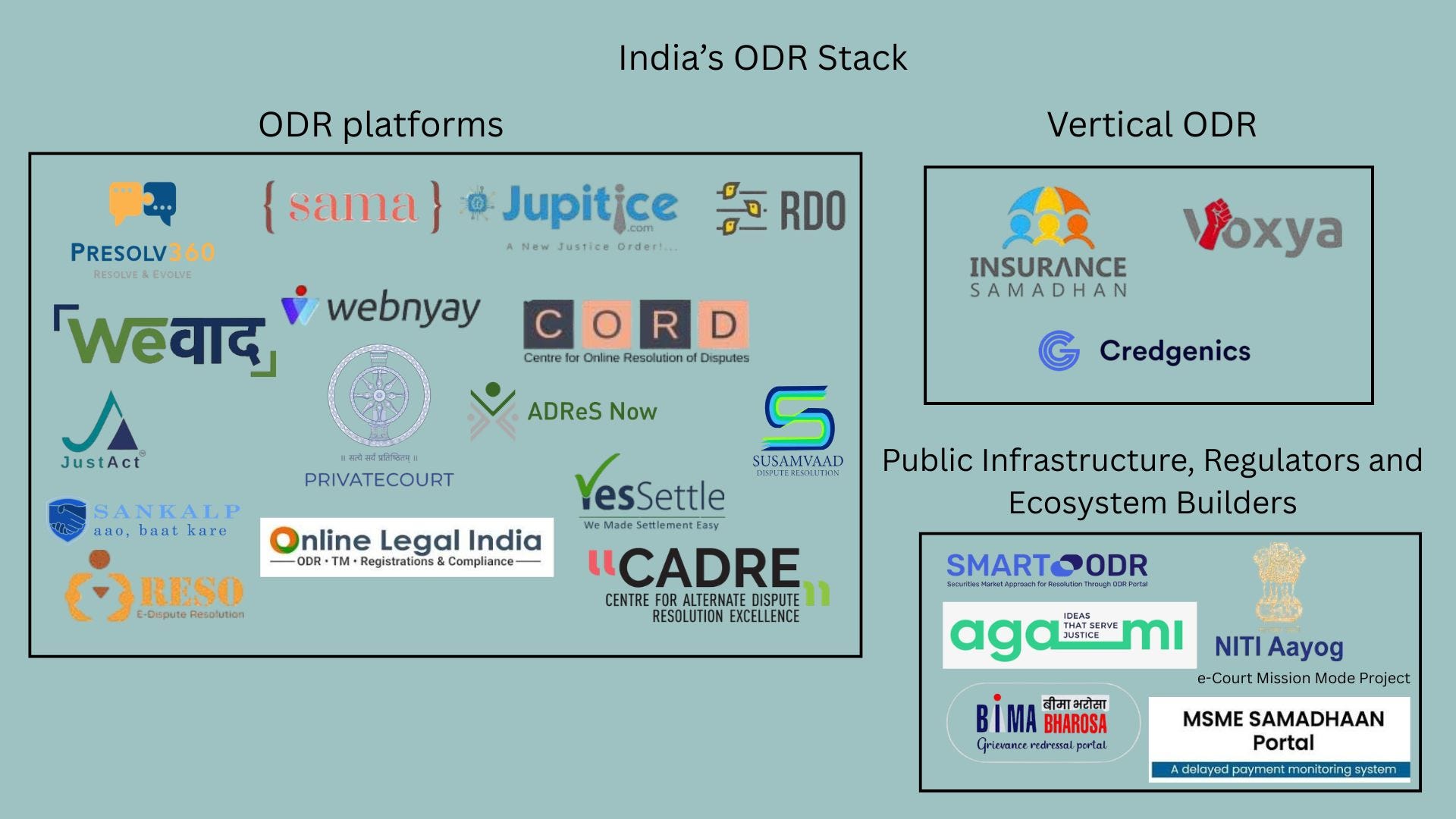
The State of India’s ODR Market
India’s ODR ecosystem is best understood as a collection of high-intensity pockets of dispute. ODR is not suitable for all disputes. It is suitable for disputes that satisfy three criteria:
Disputes that are frequent
Claims that are low to medium value
Dispute resolution directly cuts costs and improves operations
Thus, ODR in India is suitable for high-volume, low-value disputes. India’s ODR ecosystem has attracted early-stage venture capital funding across platforms that include PreSolv360 (Series A $4.7 million), Sama (Undisclosed Seed round from Campus Fund), Jupitice Justice Technologies (Pre-Series A $4 million), Resolve Disputes Online (Seed Round), Webnyay (Undisclosed Seed Round), JustAct (Undisclosed Rounds), ADRes now (Undisclosed funding rounds), CADRE ODR (Pre-Series A $200k), Insurance Samadhan (Strategic funding round Rs 8.5 crores), and Credgenics (Series B $50 million).
Across the ecosystem, the capital is following the dispute density. For example, disputes in the insurance sector surged from 2.02 lakhs in FY23 to 2.57 lakhs in FY25. Specifically, complaints related to healthcare insurance rose by 41% year-on-year to over 1.37 lakhs in FY25. ODR platforms are concentrated in sectors such as Banking & Financial Services, Insurance, Debt Collection, and Consumer complaints. Furthermore, there is an opportunity to build a vertical ODR platform for property disputes, given that more than 66% of India’s civil cases involve property or land.
Early-stage venture capital has validated ODR as a category in India. Investors are funding ODR not merely for market size or unit economics, but because it unlocks a class of disputes that were previously uneconomical to resolve. Thus, ODR not only resolves disputes in the market but also expands it. ODR’s ability to expand markets and provide such access is often referred to as “Access to Justice.” This narrative needs a tweak. It should focus not on access to justice but on access to commercial justice, specifically for MSMEs and startups. India's formalized MSME base alone now approaches 9 crore registrations across Udyam and Udyam Assist.
ODR in India is not scaling through market adoption alone but is being institutionally accelerated. The strength of the Indian ODR stack lies in the mix of horizontal and vertical platforms, as well as public infrastructure. More often than not, these startups are credited alone for creating a burgeoning ecosystem. In the case of ODR, NITI Aayog was pivotal with its policy in 2021 titled “Designing the future of Dispute Resolution in India”. This policy plan highlighted the benefits, negatives, startups, and history of ODR in India, acting as a catalyst. SEBI launched Smart ODR to resolve disputes quickly between investors and market participants and is actively refining its ODR framework. Furthermore, the government launched the Samadhan portal to actively resolve MSME payment disputes and the Bima Bharosa portal for insurance complaints.
Agami has also played a crucial role by launching the ODR initiative in 2018, which has nurtured multiple ODR startups. They’ve been crucial in driving awareness and enterprise adoption as well. While ODR startups are concerned with execution (revenue generation), regulators are concerned with defining rules. Agami serves as the coordination layer between the two because changing how an enterprise resolves a dispute requires trust and behavioral change. Without this coordination layer, adoption would be fragmented, and enterprise buy-in would be harder to achieve.
Taken together, the Indian ODR ecosystem is not a single market but a layered system in which horizontal platforms resolve disputes across sectors, verticals drive adoption within specific sectors, and institutions create demand.
The Enforcement Gap: ODR’s structural constraint
The effectiveness of a dispute resolution system depends on two pillars: the speed of the decision and the speed of enforcement. Under Section 36 of the Arbitration & Conciliation Act, 1996 (“Act”), an arbitral award shall be enforced in the same manner as a court decree. In India, even if ODR can reduce the time to resolve a dispute to 45 days, enforcement of the award remains a central bottleneck. Without it, the award loses practical force.
Arbitration, often proposed as an alternative to litigation, illustrates this gap. Empirical evidence from studies and practitioners’ reports suggests that enforcing an arbitral award can take between 1 and 2 years on average, and may be extended if an application is filed under Section 34 or 37 of the Act. Historically, India has had poor contract enforcement, reflecting continued procedural inefficiencies. In Amit Chaurasia vs ICICI Bank, a single-judge bench of the Bombay High Court, comprising Somashekhar Sundaresan, upheld the validity of a pre-agreed ODR clause while passing an order. ODR clauses are therefore contractually enforceable, with courts increasingly recognizing technology-driven dispute resolution processes.
This introduces a paradox in dispute resolution. Despite Arbitration and ODR being designed to bypass traditional litigation, they ultimately rely on the same court machinery to enforce the decision. This undermines the ODR model, as ODR platforms optimize for swift dispute resolution. However, these gains become a nullity if enforcement remains time-consuming, legally complex, and strategically delayable.
For the class of disputes that ODR targets (high-volume, low-value claims), this becomes a constraint. If enforcing the decision requires additional litigation, costs, or fees, then enforcement can exceed the value of the claim itself. In such cases, resolution without enforcement is economically meaningless.
The enforcement constraint creates three structural limitations for ODR:
Post-facto dependence on courts - Ultimately, ODR outcomes rely on traditional execution proceedings to enforce the decision.
Strategic Non-Compliance - Losing parties can challenge awards under Section 34 and, where applicable, pursue appeals under Section 37, potentially delaying enforcement where a court grants a stay.
Weak Deterrence - Delayed enforcement reduces the credibility of outcomes and weakens incentives to comply voluntarily.
ODR today optimizes for resolution, not enforcement. It reduces the time to reach a decision, but not the certainty of realizing that decision. This distinction is crucial because until this gap is addressed, ODR remains an efficiency layer atop a constrained system rather than a fully self-contained alternative.
Blockchain-based ODR: Embedding Enforcement
The enforcement gap in ODR is not merely a procedural inefficiency. It is a design limitation. The present dispute resolution mechanism separates adjudication from enforcement. A decision is reached and then enforced through external mechanisms such as court proceedings. This sequencing creates the very problems identified earlier. Blockchain-based ODR proposes a different architecture in which enforcement is embedded in the transaction itself, provided the underlying asset or obligation can be automated through a smart contract.
Blockchain-based dispute resolution proposes a different architecture that rests on three pillars:
Verifiability and Tamper-Resistant Records - Blockchain is a distributed, public ledger. Transactions once entered cannot be changed. This makes it tamper-resistant and independently verifiable.
Decentralized Adjudication - Blockchain-based dispute resolution protocols can distribute adjudicatory functions among independent jurors. The precise mechanism varies by protocol. Kleros, for example, uses token-based economic incentives and randomly selected jurors to adjudicate disputes. This varies from platform to platform.
Smart Contracts (Enforcement) - This is the most important aspect of blockchain-based dispute resolution. Smart contracts are automated programs that self-execute when certain conditions are fulfilled. An action that involves transferring funds to another party can be performed without human intervention. Where the underlying asset or payment is held on-chain, a dispute outcome can trigger an automatic transfer, release of escrowed funds, or other contractual consequence without requiring a separate enforcement proceeding. This creates the possibility of moving enforcement from an ex-post legal process into the transaction architecture itself.
Blockchain does not necessarily eliminate enforcement but changes where it occurs. When the disputed asset or payment is programmable and is controlled by the smart contract, enforcement can occur on-chain. If the outcome involves off-chain assets such as bank accounts or property, traditional legal enforcement remains necessary.
Elements of such automated enforcement already exist, such as the escrow mechanism in e-commerce and automated chargebacks in payments. Blockchain extends this logic by enabling verifiable, tamper-resistant enforcement among parties that do not share a trusted intermediary.
Globally, startups have already experimented with this model. Kleros is a blockchain-based dispute resolution protocol that uses decentralized juries and token incentives to resolve online disputes. Smart contracts are used to enforce the decision. Aragon Court is a blockchain-based dispute resolution protocol that uses token-staked jurors and smart contracts to resolve disputes. LawBlocks AI is another company that offers services such as blockchain-based arbitration and mediation. There are platforms like Jur that seek to embed AI-powered blockchain contract automation into business teams’ workflows.
Although these models differ in architecture and maturity, they demonstrate a common principle: where the disputed asset or payment is held within a smart contract, the outcome of the dispute can directly trigger its transfer or release.
In India, Blockchain-based ODR remains nascent. As cross-border digital commerce expands, particularly across lending, payments, and e-commerce, the strongest opportunities are likely to emerge where the underlying asset or obligation, such as escrowed funds or tokenized assets, can be digitally controlled to automate enforcement. Despite its promise, blockchain-based dispute resolution is not without its limitations. Questions surrounding the irreversibility of smart contracts, jurisdiction, and legal recognition remain unanswered. More importantly, the enforceability of on-chain outcomes in off-chain legal systems depends on courts, particularly when crypto assets are at issue.
Blockchain-based ODR is suited to disputes in which the legal obligation can be enforced on-chain. Examples of this include digital payments, tokenized assets, e-commerce transactions, Domain Name Disputes, and Online Gaming disputes. A smart contract can execute an outcome, but it cannot independently know what happened in the real world for goods, bank accounts, or property.
Blockchain-based dispute resolution, therefore, does not eliminate courts; it moves enforcement closer to the transaction itself. ODR optimizes the process of reaching a resolution, while blockchain-based ODR can make the outcome executable where the underlying obligation is programmable. The shift is from post-facto enforcement to enforcement by design. For digitally native disputes, blockchain-based ODR represents the next layer of India’s ODR stack.
That’s everything for this month’s deep dive. If you’re building an ODR startup and would like to be added to the market map, you can reach out to me. Furthermore, funding rounds that are not hyperlinked are based on data from Traxcn.
Related Reads:
DPDPA Compliance Tools in India: The Complete Market Map (2026) - A map of 18+ startups building India’s DPDPA compliance ecosystem, from native compliance platforms to hybrid advisors and global privacy players.
The Venture Capitalist’s Trolley Problem - An exploration of how AI investment decisions can trade off productivity and abundance against employment, professional agency, and the apprenticeship models that create future experts. The piece asks a broader question: when VCs fund AI, are they merely backing companies or helping decide which version of the future of work gets built?
Three LegalTech Whitespace Plays in 2026: AI-Native Legal Services, Domain-Specific AI Agents & Cybersecurity Solutions - There are three opportunities I see for Legal AI in 2026: AI-Native Legal Services, Domain-Specific AI Agents, and Cybersecurity Solutions. This post makes the case for why now is the right time to build in these areas.